

Um dia em uma cidade desconhecida
Quando Lucas chegou a uma cidade brasileira que não conhecia, percebeu rapidamente que precisaria se organizar para conseguir visitar todos os lugares que tinha planejado. Ele estava hospedado em um hotel no centro e queria conhecer um mercado, um museu e um restaurante famoso que ficava em outro bairro.
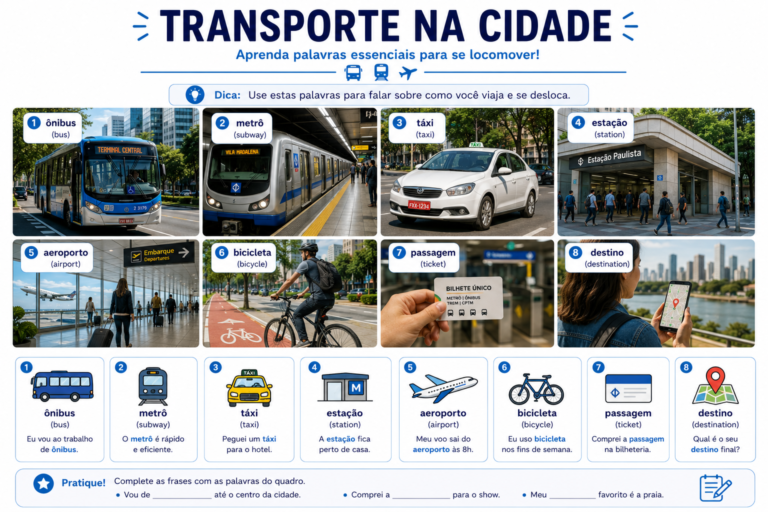
Na primeira manhã, Lucas decidiu ir ao mercado de ônibus. Antes de sair do hotel, perguntou ao recepcionista qual linha deveria pegar e onde deveria descer. O funcionário explicou que ele precisava caminhar por aproximadamente cinco minutos até um ponto de ônibus próximo e pegar uma linha que passava pela avenida principal. Também recomendou que Lucas confirmasse com o motorista se aquele ônibus realmente passava perto do mercado.
Durante o trajeto, Lucas percebeu que o trânsito estava bastante intenso. O ônibus avançava lentamente e algumas pessoas começaram a reclamar do atraso. Como não tinha compromisso naquele momento, Lucas decidiu continuar no ônibus. Depois de alguns minutos, chegou ao ponto indicado pelo motorista.
Para chegar ao mercado, ainda precisava atravessar uma avenida movimentada. Uma senhora que estava no ponto de ônibus percebeu que ele estava procurando uma direção e perguntou se precisava de ajuda. Lucas explicou para onde queria ir. Ela disse para ele seguir em frente por dois quarteirões, virar à esquerda depois de uma farmácia e continuar até encontrar uma praça. O mercado ficava logo depois da praça.
À tarde, Lucas decidiu visitar o museu. Dessa vez, preferiu usar o metrô porque queria evitar o trânsito. Ele caminhou até a estação, comprou o bilhete e perguntou a um funcionário qual plataforma deveria usar. O funcionário explicou que ele precisava pegar o trem no sentido contrário ao centro e fazer uma conexão em outra estação.
Lucas quase entrou no trem errado, mas percebeu a tempo que a direção não correspondia ao que o funcionário havia explicado. Em vez de ficar confuso, perguntou novamente e confirmou o caminho antes de entrar. Depois da conexão, chegou ao museu sem problemas.
À noite, Lucas encontrou alguns amigos em um restaurante. Como estava cansado e não queria esperar pelo transporte público, decidiu chamar um carro por aplicativo. O motorista chegou rapidamente e Lucas mostrou o endereço no celular. Durante a viagem, percebeu que o restaurante ficava em uma rua pequena e difícil de encontrar. O motorista precisou diminuir a velocidade e perguntar a um funcionário de uma loja onde ficava o número indicado.
No final do dia, Lucas percebeu que conhecer diferentes formas de transporte tornou a viagem muito mais fácil. Ele também descobriu que, em uma cidade desconhecida, saber pedir informações é tão importante quanto saber ler um mapa. Nem sempre o caminho mais rápido é o mais barato, e nem sempre o transporte mais barato é a melhor opção. Dependendo do trânsito, da distância e do horário, é importante comparar as alternativas antes de tomar uma decisão.
Ver tradução
Mostrar tradução em inglês
When Lucas arrived in a Brazilian city he did not know, he quickly realized that he would need to organize himself if he wanted to visit all the places he had planned. He was staying at a hotel downtown and wanted to visit a market, a museum, and a popular restaurant in another neighborhood.
On the first morning, Lucas decided to take the bus to the market. Before leaving the hotel, he asked the receptionist which line he should take and where he should get off. The employee explained that he needed to walk for about five minutes to a nearby bus stop and take a line that passed along the main avenue. He also recommended that Lucas confirm with the driver whether the bus really passed near the market.
During the journey, Lucas noticed that the traffic was very heavy. The bus was moving slowly and some people started complaining about the delay. Since he had no appointment at that moment, Lucas decided to stay on the bus. After a few minutes, he arrived at the stop indicated by the driver.
To reach the market, he still had to cross a busy avenue. An older woman who was at the bus stop noticed that he was looking for directions and asked if he needed help. Lucas explained where he wanted to go. She told him to go straight for two blocks, turn left after a pharmacy, and continue until he found a square. The market was just after the square.
In the afternoon, Lucas decided to visit the museum. This time, he preferred to use the subway because he wanted to avoid traffic. He walked to the station, bought a ticket, and asked an employee which platform he should use. The employee explained that he needed to take the train in the opposite direction from downtown and transfer at another station.
Lucas almost got on the wrong train, but he realized in time that the direction did not match what the employee had explained. Instead of getting confused, he asked again and confirmed the route before getting on. After the transfer, he arrived at the museum without any problems.
At night, Lucas met some friends at a restaurant. Since he was tired and did not want to wait for public transportation, he decided to order a ride through an app. The driver arrived quickly and Lucas showed the address on his phone. During the trip, he realized that the restaurant was on a small street that was difficult to find. The driver had to slow down and ask an employee at a store where the indicated number was.
At the end of the day, Lucas realized that knowing different forms of transportation made the trip much easier. He also discovered that, in an unfamiliar city, knowing how to ask for directions is just as important as knowing how to read a map. The fastest route is not always the cheapest, and the cheapest transportation is not always the best option. Depending on traffic, distance, and time of day, it is important to compare the alternatives before making a decision.